It's not a problem of presence. It's a problem of strategy.
Personal branding on LinkedIn isn't about uploading a new cover photo or writing reflections on Monday mornings. It's a system for building authority that, when well-constructed, transforms visibility into qualified leads. In B2B environments, where the sales cycle is long and trust is paramount, the executive's profile is often the first real point of contact with the potential client.
This guide isn't for community managers. It's for executives who make decisions and want LinkedIn to work for their pipeline.
Why an executive's personal branding is more impactful than a company's.
Company pages on LinkedIn have an average organic reach of between 2% and 5% of their followers. A personal profile can exceed 20% with well-crafted posts.
But it's not just reach. It's credibility.
In complex B2B sales, software projects, consulting, infrastructure, and managed services, the buyer doesn't hire the company. They hire the people behind the company. The CEO, sales director, or project manager who demonstrates sound judgment, experience, and market insight on LinkedIn is closing a part of the sales cycle before the first meeting.
An executive with authority on LinkedIn reduces the Customer Acquisition Cost (CAC). It shortens the decision cycle. And it raises the perceived price of the service before the proposal even arrives.
The three mistakes that nullify the potential of a managerial profile
Error 1: Confusing visibility with impact
Posting frequently without a strategy generates low-quality engagement: likes from colleagues, generic comments, no SQL. The goal isn't reach metrics. It's the quality of who reads you and what they do afterward.
Mistake 2: Talking about the company instead of talking about the customer's problem
"We are leaders in X, with over 15 years of experience..." This is the kind of content no one reads. What holds attention on LinkedIn B2B is content that names a problem the reader already has but couldn't articulate.
Mistake 3: Separating LinkedIn from business strategy
LinkedIn isn't a communication channel. It's a sales channel. If it's not integrated with your CRM, pipeline goals, and buyer's journey, it's just noise. Expensive in time, with no return on investment.
The five pillars of a B2B personal branding strategy on LinkedIn
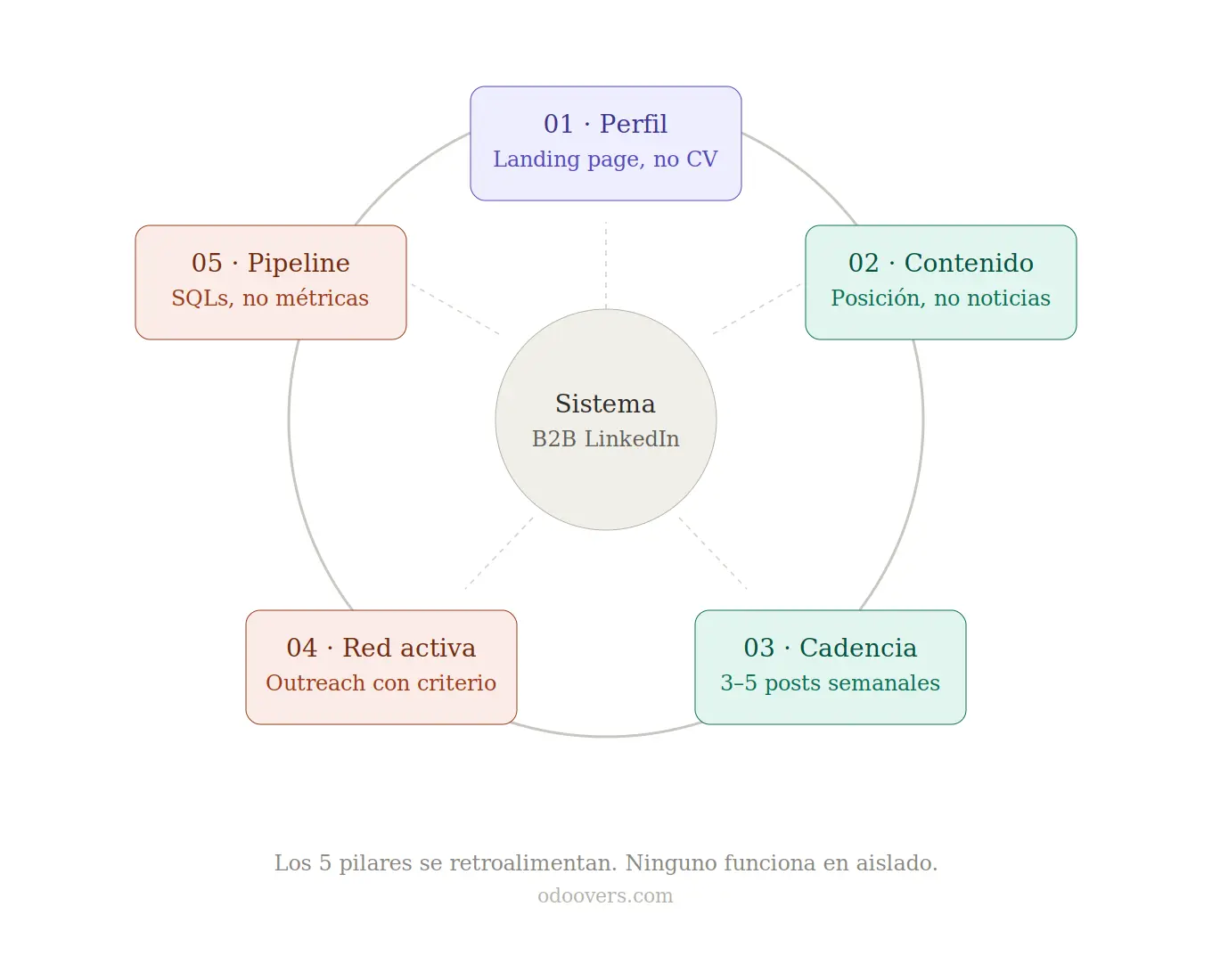
1. Profile positioning: the first to convert
A profile is not a CV. It's a landing page.
The headline should answer a specific question: Who do you help and with what results? Not "CEO at [company]". Something like: "I help industrial companies reduce their operating costs by integrating ERP with their production processes."
The 'About' section is the first long text that the potential buyer reads.
It must follow a diagnostic structure:
Market problem → manager's perspective → how to solve it → proof of results.
No corporate rhetoric. Use figures whenever possible.
The optimized profile doesn't wait for the client to arrive. It's already working.
2. Content positioning: authority is demonstrated, not declared
In LinkedIn B2B, authority is built by taking a stand. Not by posting industry news. Not by sharing third-party articles with an "interesting thought." By taking a stand.
A manager with their own judgment says things like:
- "70% of digital transformation projects fail due to a lack of internal adoption, not due to technology. And nobody is measuring it."
- "If you need a 40-page RFP to evaluate a supplier, your purchasing process is the problem."
These messages generate positive polarization: the right readers identify with them. The wrong ones scroll past. That's passive qualification.
3. Publication cadence: consistency over quantity
The optimal frequency for B2B management profiles is between 3 and 5 posts per week. Fewer posts don't generate enough algorithmic presence. More posts dilute the perception of depth.
The content mix that works:
- 60% personal perspective and judgment : opinions on the market, common mistakes in the sector, trends with a clear position.
- 25% cases and results : real situations (without revealing clients if there is no authorization), metrics, before and after.
- 15% company context : launches, collaborations, events. Only when it has real informational value for the customer.
What should never appear: generic motivational content, internal celebrations without external context, posts saying "thank you to the team for their effort".
4. Active network building: content alone is not enough
A personal branding strategy on LinkedIn that relies solely on content is incomplete. The network is the infrastructure.
The manager should have a weekly practice of:
- Segmented connection requests: target sector decision-makers, not random volume.
- Strategic comments on publications of potential clients or industry leaders: not flattery, but contributions with your own opinion.
- Direct messages to start a conversation: based on a real point of contact (post, shared event, industry problem), never a direct sales pitch.
The goal of outreach on LinkedIn isn't to sell. It's to start a conversation with a decision-maker who isn't yet familiar with the company. If the profile is well-crafted, that decision-maker will have already engaged with relevant content before responding.
5. Pipeline integration: the metric that matters
Without CRM integration, personal branding on LinkedIn is professional entertainment.
The metrics that should be measured:
- Conversations initiated per week (inbound from profile + own outreach)
- Conversation to Qualified Meeting Conversion Rate
- SQLs originated from LinkedIn per quarter
- Influence on the closing cycle : how many active opportunities have the decision-maker following the profile before signing
If none of these metrics exist, LinkedIn is disconnected from the business.
The managerial profile as a sales asset in the B2B ecosystem
In long-cycle B2B sales, the buying decision is rarely spontaneous. The buyer has spent weeks or months consuming information, evaluating alternatives, and developing criteria. By the time they arrive at the meeting, they already have a formed opinion.
The relevant question is not whether the executive should be on LinkedIn. It's whether they want that opinion to be formed with or without their influence.
A well-developed executive profile is an asset that works outside of business hours. It qualifies leads before they reach the sales team, reduces decision time, and positions the price before it appears in the proposal.
It's not communication. It's a lever for growth.
How to connect personal branding with your content strategy in Odoo
A personal branding strategy on LinkedIn generates demand. But that demand needs a system where candidates can land, qualify, and move up the pipeline.
At Odoovers, we design B2B content strategies integrated with the Odoo ecosystem : from lead generation on LinkedIn to automating sales follow-up within the CRM. If you want your LinkedIn visibility to translate into measurable opportunities, start there.