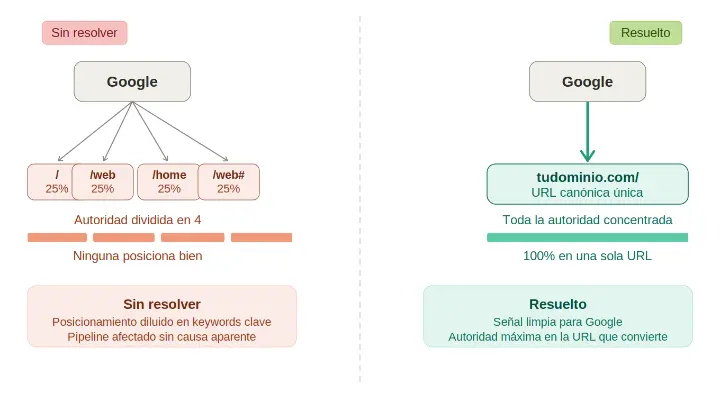
Google is tracking two versions of your most important page, the homepage, and dividing the authority that should be concentrated on a single URL.
We call it the ghost home. And if you have Odoo, you probably have it.
What exactly is the ghost home in Odoo
Odoo generates, due to its internal architecture, a duplicate homepage that silently coexists with the real one. It is not a user configuration error. It is the default behavior of the platform when there is no intervention with specific knowledge of how its backend works.
The result:Google crawls both URLs, indexes them as independent pages, and this creates duplicate content. This leads to Google not knowing which page to prioritize for indexing and then for subsequent ranking. When this happens on the most important page of the entire website (the homepage), this problem will affect the rest of the website. The site loses ranking on its most important keywords without anyone understanding why. There are no alerts. There are no notifications. Just a gradual decline that is attributed to competition, the algorithm, or any other cause.
The real cause is structural and has a concrete solution.
Why does this happen and not in other CMS?
This problem is specific to Odoo because its Website module was not originally designed with SEO as a priority. It was designed to manage operations. The web layer is a functional extension of an ERP, not a content platform optimized for search engines.
When Odoo builds the homepage, it generates technical routes specific to the system that coexist with the public URL. For the user, they are invisible. For Google's crawler, they are distinct pages with identical or very similar content. Without an explicit configuration telling Google which is the real version, the crawling system does what it can: it indexes both and distributes.
There is no general-purpose CMS that generates this behavior so consistently. It is a problem that only occurs here, and it can only be resolved with knowledge of how the Odoo backend works.
How to diagnose if you have the problem
Before acting, confirm that the ghost home exists in your installation.
Direct search on Google: Type site:tudominio.com in Google. If more than one variant of the homepage appears in the results (/web, /home, /, /web#), the problem is confirmed and active.
Sitemap review: Access tudominio.com/sitemap.xml. If the sitemap includes more than one representation of the homepage, Google is receiving ambiguous instructions on which version to prioritize.
Redirect Analysis: Use Screaming Frog or any crawling tool to check what HTTP code each variant of the homepage returns. If any respond with a 200 instead of a 301 to the canonical URL, it is being treated as an independent page by search engines..
The solution: consolidation of authority in a single canonical URL
We have developed the exact configuration in the Odoo backend to eliminate the ghost homepage and consolidate all SEO authority on the main URL. Once applied, Google receives a clear and unambiguous signal about which is the actual homepage of the site.
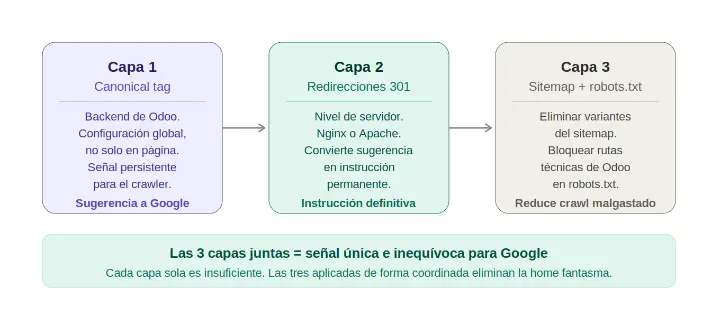
The process has three layers that must be applied in a coordinated manner:
First layer: canonical tag in the Odoo backend
It is not enough to add the canonical from the page editor. The configuration must be done from the system settings to ensure consistency across all routes automatically generated by the platform. A canonical added only at the page level can be overwritten by Odoo under certain conditions. The lasting solution goes to the backend.
Second layer: server-level 301 redirects
Every variant of the homepage that is not the canonical URL must return a permanent redirect. This is not optional. Without the 301, the canonical works as a suggestion, not as an instruction. Google can ignore it. The 301 is the definitive technical signal that consolidates authority into a single URL.
Third layer: cleaning of the sitemap and robots.txt
The sitemap should only contain the canonical URL of the homepage. Any additional variants should be removed or marked as non-indexable. The robots.txt should block the crawling of Odoo's technical paths that have no value for SEO but consume crawl budget.
What changes when it is resolved
All the authority that was fragmented between two or more versions of the homepage is consolidated into a single URL. Google receives a clear, unambiguous signal about which page represents the site's homepage.
The effect on positioning is not immediate. It depends on the frequency of domain crawling and the time it takes for Google to process the changes. In most cases, the impact begins to be visible between 3 and 6 weeks after applying the settings.
What is immediate is that the problem ceases to exist. The authority stops being divided. Each new link pointing to the site reinforces a single URL instead of two.
Why this matters more in the Odoo ecosystem
In a B2B business with long sales cycles, the homepage is not just a page. It is the entry point for most of the brand traffic, the anchor of the internal link architecture, and the URL with the highest natural authority of the domain.
Losing positioning on the keywords that carry your name or define your category has a direct impact on the pipeline. On the cost of acquisition. On the closing rate of leads that come from organic search.
And in the Odoo ecosystem, where most partners and companies lack visibility on this issue, solving it correctly is a real competitive advantage.
Is your website on Odoo capturing real opportunities or just generating traffic?
The ghost homepage is the most common problem we encounter in SEO audits of websites built on Odoo. It is almost never alone.
If you want to know exactly what is limiting the organic performance of your site and how to turn it into a lead generation channel that creates qualified opportunities, we work on that here.